

A Box of Leaf Tea, a Magnifying Glass and One Circled Line
A retired science librarian reads a single-herb tea the way she used to read a journal: the label, the study, the reviews and the fine print. Twenty-four bags of organic gymnema leaf, about 62 cents a cup, no promises.

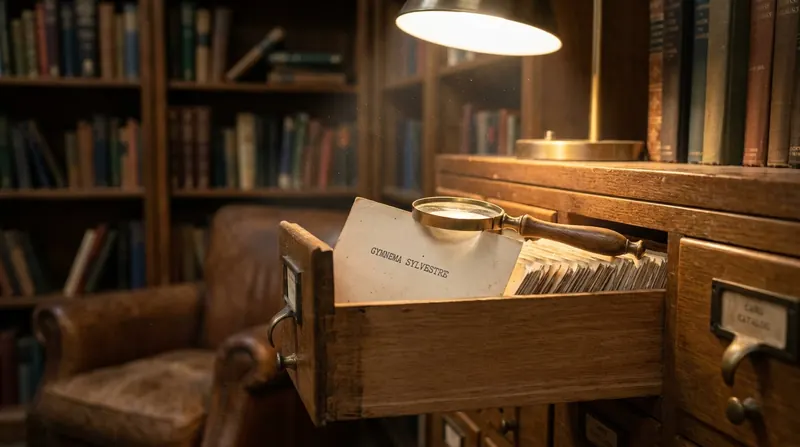
First, the people: Corinne Haldane is a pen name, and Walt, Meena and the Friends of the Library volunteers are composites, the way columns like this have always been told.
Everything about the tea itself comes from the seller's own product page, its box, its published reviews and its contact page, all read in October 2026.
And one thing before the story, because I was a reference librarian for thirty-one years and I cannot help myself: this page is an advertisement. The disclosure at the foot says so plainly.
In March, at my annual checkup, my doctor slid the lab printout across the desk with one line circled in blue ballpoint.
She tapped it twice with the pen cap. "This one's worth watching," she said.
"We'll look again in six months. And let's talk about your afternoons."
I'm not going to print the number. It's mine, and it belongs to her office and to me, not to a column.
But I will tell you what I did with the printout, because it's the most librarian thing I've ever done.
I folded it in thirds, the way you'd fold a call slip, and tucked it into the back pocket of my reading notebook, right where the old date-due cards used to go.
Then I drove home, put the kettle on out of pure habit, and sat down at the kitchen table to think about my afternoons.
Thirty-One Years of Other People's Questions
For thirty-one years I worked the science reference desk at a university library in North Texas.
People came to that desk with questions they were sometimes embarrassed to ask, and my job was to find the best answer the shelves had, not the answer they hoped for.
A graduate student once asked me for "the study that proves" a thing. I spent forty minutes showing him why there wasn't one, and he thanked me a year later.
We called it the reference interview. You listen to the question, then you ask the question behind the question, and then you go to the stacks.
Over the years, a surprising number of patrons came to that desk holding a box. A jar from a health-food store, a pamphlet from the mailbox, once a whole grocery bag of bottles a widower had found in his late wife's cabinet.
They all asked the same thing in different words. "Is this real?"
And I always gave the same answer, which I learned from the woman who trained me in 1979, a tall Oklahoman named Mrs. Purcell who wore her glasses on a chain and never once raised her voice.
"We don't decide whether it's real," she told me my first week. "We find out what's been written about it, who wrote it and how they knew.
Then the patron decides."
Mrs. Purcell had a second rule, which she taught me with a red pencil.
Every claim gets three questions: compared with what, in whom, and made of what. I've never found a better filter for anything with a health word on it.
I didn't know it in March, but I'd be asking those three questions about a small box of tea before the summer was out.
So that afternoon in March, with the printout in the notebook, I did what I always did. I interviewed myself.
The question on the surface was simple: what was my doctor really asking about my afternoons?
The question behind it took me a week to admit, and it had a kolache in it.
The Three O'Clock Kolache and Forty Pages
If you have never lived in Texas, a kolache is a soft, cloud-light Czech pastry, round as a saucer, with a dollop of fruit or sweet cheese pressed into the middle.
My husband Walt drives to a bakery out on the interstate every Saturday morning and comes home with a white box of a dozen, like his father did before him.
For years, my afternoons went like this. Lunch at noon.
A kolache from the box at three, with a cup of coffee, three sugars and a splash of hazelnut creamer.
Then I'd settle into the green chair by the window with whatever book the library sale had sent home with me, and I would read.
I used to measure my afternoons in pages, the way some people measure them in miles walked. Forty pages was a good afternoon, and fifty was a great one.
Somewhere in the last two years, without my noticing, forty pages had become eight.
I'd read a page, then the same page again, and then I'd wake up at a quarter past four with the book face-down on my chest and Walt pretending he hadn't seen.
I had filed it under "getting older" the way you file a book you don't want to deal with under "miscellaneous." Out of sight, technically shelved.
Walt noticed before I did, of course. Husbands of forty-one years notice everything and mention about a tenth of it.
"You used to read me the good parts," he said one evening in February. He was right: every afternoon I used to read him a paragraph out loud, whatever made me laugh or gasp.
Somewhere along the line I'd stopped. I told him I was tired, and he said, "Of what?"
I didn't have an answer, which for a reference librarian is the most uncomfortable feeling there is.
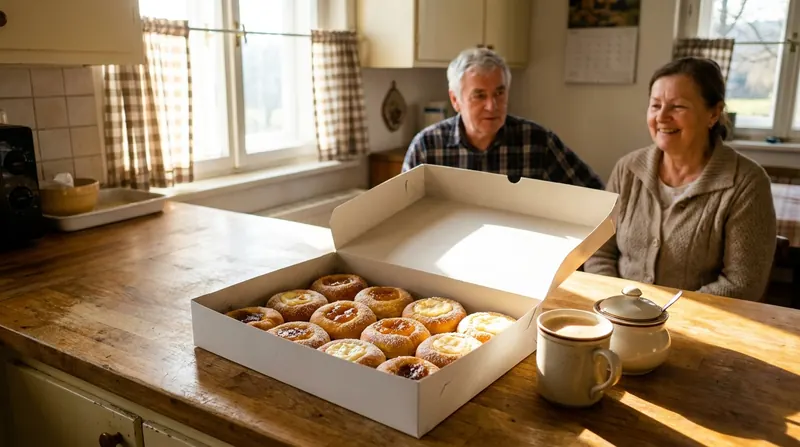
When my doctor said "let's talk about your afternoons," I knew she meant the kolache and the three sugars and the nap, and I knew she was right.
What she proposed was not dramatic. A walk after lunch, even fifteen minutes.
A look at what was in the three o'clock cup. Another look at the numbers in September.
She also said something I've repeated to half the women at my church since. "Don't go buying anything off the internet that promises to fix a lab value.
Bring me what you find and we'll read it together."
That sentence is why this column exists. I found something, and I read it, and in September I brought it to her.
That's the order things happen in at my house.
What a Librarian Does With a Worry
Some people pray over a worry and some people bake over one. I catalog mine.
The reading notebook is a plain composition book with a marbled cover, the kind every school kid in Texas carried in 1968.
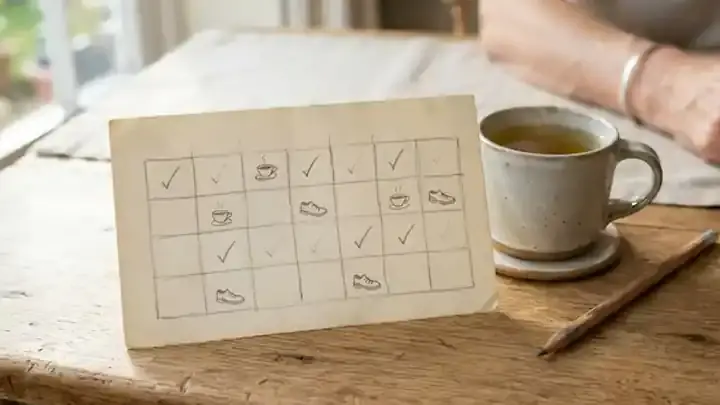
On the left-hand pages I keep the books: title, author, the page I stopped on, a line I liked. On the right-hand pages, starting in March, I began keeping the afternoons.
Not numbers from a meter. I don't own one, and my doctor didn't ask me to buy one.
Just the shape of the afternoon in plain words.
What was in the cup. Whether I walked.
How many pages I read before my eyes closed. Whether the kolache was a whole or a half or a "not today."
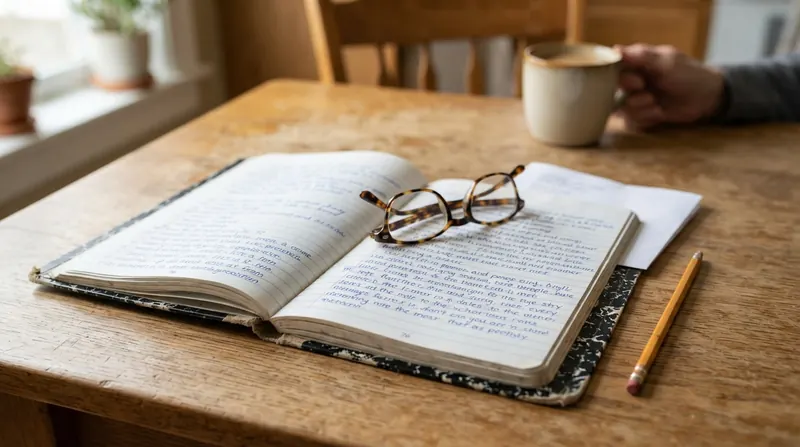
The first three weeks of the notebook were humbling. Here is a fair summary of what I wrote.
That last entry made me laugh out loud when I read it back, and then it made me sit very still.
A cataloger's first rule is to describe what's in front of you, not what you wish were there. What was in front of me was a woman who had built her whole afternoon around something sweet.
The walk came first, and it came easily. Walt started coming with me after the second day, mostly to complain about the heat, and the complaining turned out to be good company.
We walk the same loop every day: down to the corner with the live oak that the city keeps threatening to trim, past the house with the three concrete geese dressed for every holiday, and back. Fifteen minutes if Walt doesn't stop to talk to the neighbor about his lawn mower, twenty-five if he does.
By May the geese were wearing graduation caps, and I had started writing their outfits in the notebook too. A cataloger records what's in front of her.
The cup was harder. Coffee without sugar tasted like a punishment, and decaf tasted like a rumor of coffee.
Plain hot water felt like I'd been sent to my room.
I tried everything in the pantry first. Chamomile tasted like a hospital waiting room, and peppermint was lovely at nine at night and wrong at three in the afternoon.
Lemon in hot water made me want a lemon bar, which defeated the purpose. Walt suggested a diet soda, and I gave him the look I used to give students who shelved by color.
I needed something warm to hold at three o'clock that wasn't a dessert in disguise, and I had no idea what it was.
I didn't find it in a catalog. Someone handed it to me across a folding table full of paperbacks.
Meena, the Folding Table and a Vine From Madurai
The Friends of the Library hold a used-book sale on the second Saturday of every month in the community room behind the branch library.
I have volunteered at it since the week I retired. I run the science and nature tables, which means I spend four hours defending field guides from people who want them for a dollar.
Meena Iyer runs the cookbooks and the travel books, one table over. She is seventy-one, taught high school chemistry for thirty years, and has never once let me win an argument about the periodic table.
Meena came to Texas in 1979 with a chemistry degree from Madras and two suitcases.
She taught at a high school in Denton until she retired, and half the pharmacists in the county still call her "Mrs. Iyer."
She reads labels too, but the way a chemist does: the compound first and the marketing last. Between the two of us, a box doesn't stand much of a chance.
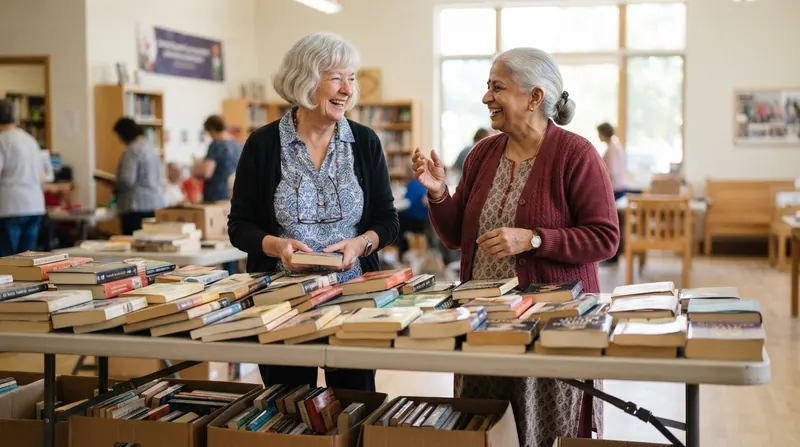
In April, during the slow hour after lunch, she caught me staring at the bake-sale table by the door like it owed me money.
"You've been looking at those lemon bars for twenty minutes," she said. "Either buy one or tell me what's wrong."
So I told her. The circled line, the doctor, the afternoons, the kolache, the notebook.
All of it, in the voice I used to use for a patron's question.
She listened the way chemistry teachers listen, which is with her whole face. Then she reached under her table into her tote bag.
"Here," she said, and put a small box on top of a stack of Julia Child. "Don't make that face.
It's tea, nothing more and nothing less. Try one cup and then try a lemon bar."
The box was white and purple, with a sprig of green leaves on the front and the words Organic Gymnema Leaf Tea. Twenty-four bags.
I turned it over in my hands the way I'd turn over a book with a suspicious publisher. "Gymnema," I said.
"I don't think I've ever catalogued a gymnema."
"You wouldn't have," Meena said. "In my grandmother's house it had an older name, and it didn't come in a box.
She grew it on a trellis behind the kitchen in Madurai."
Meena gave me a box of gymnema leaf tea today, one ingredient.
6:12Have you made a cup yet, or is it under the magnifying glass?
6:15Under the lamp. The label first, then the kettle.
6:16That's my sister. Tell me what it tastes like.
6:18A Vine in Madurai and a Sugar Cube That Tasted Like Sand
Then Meena told me a story, and I'm going to give it to you the way she gave it to me, because it was the first thing about this tea that I could check with my own tongue.
When she was a girl, her grandmother kept the vine on a bamboo trellis near the back door, with leaves about the size of a thumb and small yellow flowers in the hot months.
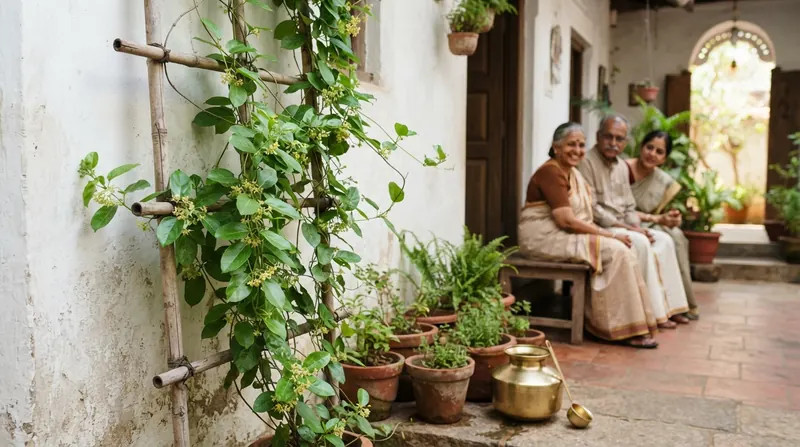
The children of the house had a game. You chewed one leaf, counted to sixty, and then someone handed you a piece of jaggery, the raw cane sugar of South India.
"And it tasted like sand," Meena said. "Like wet sand.
My cousin cried the first time. My grandmother laughed so hard she had to sit down."
The old name for the plant, she told me, comes from exactly that game, because the leaf makes sweet things taste like nothing for a little while. I'll come back to that name in the stacks, where names belong.
I wrote that down in the notebook with a question mark, because a name is a name, not a finding. A reference librarian never accepts a nickname as a citation.
But the taste part I could test that same afternoon. Meena insisted, and so did the lemon bars.
We borrowed the community room's electric kettle. She steeped one bag in a paper cup, and I sipped it, and it tasted like a meadow that had been left in the sun: green, a little bitter, not unpleasant.
Then she handed me a sugar cube from the coffee station. I put it on my tongue and waited for sweetness, and it didn't come.
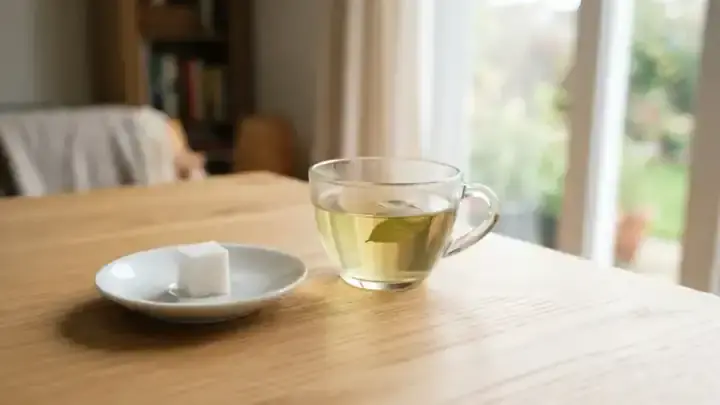
It was the strangest thing. I could feel the cube, the grit of it, the way it dissolved.
The sweetness just wasn't there, as if someone had turned down a dial.
The lemon bar was the same story. Lemon, yes.
Butter, yes. Sweet, hardly.
Meena looked enormously pleased with herself.
By the time I got home, maybe forty minutes later, the effect had faded. Walt's Saturday kolache, left over in the box, tasted like a kolache again.
A name is a name, not a finding. But a sugar cube on your own tongue is a fair place to start a question.
I want to be very careful about what that afternoon was and wasn't, because that care is the whole point of this column.
What I felt was a taste effect. The box itself says it plainly: gymnema "may temporarily reduce the sensation of sweetness."
It's a tongue thing. I could feel it, and so can you.
What it was not was evidence about anything happening past my tongue, about my afternoons, or about the line my doctor circled. Those are different questions on different shelves.
But a librarian who has just had a sugar cube turn to sand in her mouth does not go home and watch television. She goes to the stacks.
The Label, Read Line by Line at the Kitchen Table
That night I laid the box on the kitchen table under the good lamp, got out the magnifying glass I keep for the small print on vitamin bottles, and read it the way we used to read a new acquisition.
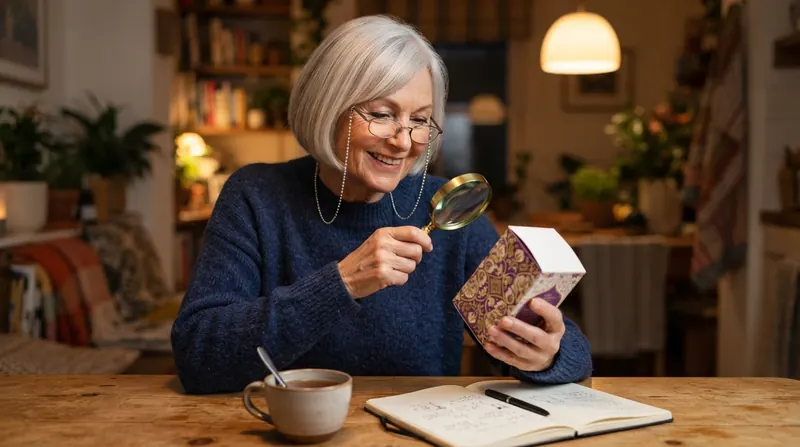
The maker. Herbal Goodness LLC, with a mailing address in Little Elm, Texas, which is about a forty-minute drive from my kitchen if the toll road behaves. Their page also lists a toll-free phone line and an email.
The ingredient list. One line. Organic gymnema sylvestre leaf.
No blend, no flavoring, no sweetener, no filler. I have catalogued shorter books, but not many.
The amount. The box doesn't print milligrams per bag, and the product page doesn't either. It does print a net weight on the front: 1.69 ounces, or 48 grams, for 24 bags.
So I did the arithmetic every librarian does on the back of an envelope. Forty-eight grams divided by twenty-four bags is about two grams of dried leaf in each one.
That's not a dose in any clinical sense, and I'm not offering it as one. It's simply what's in the bag, and you're entitled to know it.
The format. Caffeine-free herbal tea, individually wrapped bags. The box calls itself an herbal tea supplement and carries the standard statement that the Food and Drug Administration has not evaluated its claims.
The seals. USDA Organic on the front. The product page adds Non-GMO, vegan and gluten-free, and says the leaf is third-party tested and packed in a GMP-certified facility registered with the FDA.
Registered and certified are paperwork words. They mean the forms were filed and the facility follows manufacturing rules.
They do not mean a tea has been proven to do anything, and the company doesn't say they do.
The directions. One bag in eight ounces of hot water, steeped five to seven minutes. The page describes the taste as mild and slightly bitter, suggests honey, and says one to two cups a day before meals.
The honest footnote. The seller's own page adds that gymnema "may temporarily reduce the sensation of sweetness." So the sugar cube was right there in the fine print the whole time.
I catalogued a tea box tonight. One ingredient, 48 grams, a street address in Little Elm.
9:40Subject heading?
9:44Herbal teas, single leaf. Call number pending.
9:45Send me a photo of the card. I miss the drawer.
9:47There was one more thing on the box, and I'd be a poor reviewer if I skipped it.
The front panel borrows the old Sanskrit nickname, translated into English, and pairs it with a short phrase about an internal organ.
I'm not going to reprint either one here. A nickname from a children's game and a two-word phrase on a front panel are marketing, not findings, and this column doesn't print what it can't support.
I'll say this for the company, though: the back of the same box carries the FDA statement in plain type, and the product page says, in so many words, that the tea isn't meant for any medical purpose.
I underlined that sentence twice in my notebook. In my experience, it's the most important sentence on any box.
The Study, Read Under the Magnifying Glass
The next morning I did what I did for thirty-one years: I went looking for the best evidence the shelves had, not the loudest.
You don't need a university login to do this anymore. The National Library of Medicine runs a free index of medical journals that anyone can search from a kitchen table, and I've been teaching retirees to use it for years.
I searched the plant's Latin name and the words "systematic review." What came back first was a 2021 review and meta-analysis in the journal Phytotherapy Research.
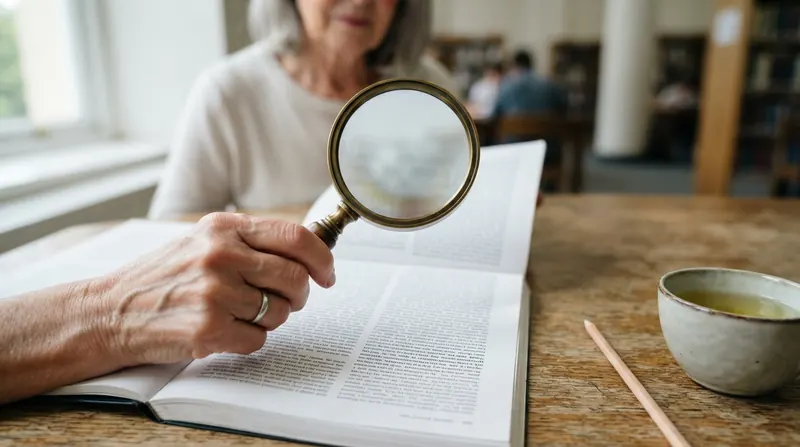
A meta-analysis, for anyone who never had to explain one to a sophomore, is a study of studies. The authors gather every trial they can find on a question and pool the results to see what the whole pile says.
Before I read a single number, I did what Mrs. Purcell taught me and checked the plant's name in the paper against the name on the box.
They matched: Gymnema sylvestre, the same Latin name printed on Meena's box.
While I was at it, I looked up the older name. A 2007 review of the plant in a Japanese nutrition journal records it as gurmar, from the Hindi, and ties it to the same effect on sweet taste that Meena's cousin cried about. [1]
That's where a traditional name belongs: in the background section, labeled as tradition. It's history, not a result, and I filed it under history.
This one pulled together 10 studies with a total of 419 participants. That's the headline number, and it's the first thing I want you to hold up to the light. [2]
Four hundred and nineteen people, across ten studies, means the average study had about forty people in it. Some were smaller.
That's a small pile, and the authors were working with what existed.
The authors reported that gymnema supplementation was associated with lower readings, both in the morning and after meals, and on a longer-term lab measure, compared with where those participants started. [2]
Now pick up the magnifying glass with me, because the next three details are where a reference librarian earns her pension.
"Compared with what? Compared with their own starting point, not with a group that drank something else. Who? Adults whose numbers were already being followed by a clinic. Made of what? Leaf powders and extracts, not a tea bag from a kitchen in Texas."
— Corinne's margin note, reading the 2021 review, Three questions she asked of the paper before she believed a word of it[2]
First: compared with what. The review compared each group's numbers after the herb with the same group's numbers before it. It didn't pool comparisons against a placebo group drinking something that looked the same.
That matters more than it sounds. People who join a study change things.
They walk more, they eat more carefully, they show up for appointments. Comparing people with their own earlier selves can't separate the herb from all of that.
Second: who. The participants were adults already under a clinician's care for their numbers. Their situation is not mine, and it may not be yours.
You can't borrow a finding from one group of people and pin it on another.
Third: made of what. The studies used gymnema leaf powders and extracts in various amounts, not a two-gram tea bag steeped for six minutes. Nobody has run a trial on this box, and the company doesn't claim anyone has.
And there's a fourth thing, buried in the statistics, that I'd circle in red if I still graded bibliographies.
Meta-analyses report a measure of how much the studies disagree with each other. In this one, that measure ran from high to nearly as high as it can go.
In plain words, the ten studies did not tell the same story.
When studies disagree that much, pooling them is a little like averaging the weather in Amarillo and Galveston. You get a number, and the number is real arithmetic.
But it doesn't describe any afternoon anyone actually lived through. The authors said as much in their own discussion, which is to their credit.
So here is my reference-desk verdict, the one I'd give a patron who asked me whether gymnema "works."
The research is interesting, it's small, and it points in a direction worth studying properly. It is not proof, it is not about tea bags, and it is not about you or me.
If someone shows you a box like this with a percentage on it, ask them where the percentage came from. I looked, and I couldn't find one I'd stand behind.
A word about placebo groups, because it came up at every book-sale table where I told this story.
In the strongest kind of study, half the people get the real thing and half get something that looks, smells and tastes the same but isn't. Nobody, not the participants and not the people measuring, knows who got which until the end.
That design exists because life changes during a study whether you take anything or not. Without a look-alike group, you're comparing a person in March with the same person in June, and a great deal happens between March and June.
The 2021 review didn't pool results that way. That isn't a criticism of the authors; it's a description of what existed for them to pool.
A Word About Cinnamon, the Cautionary Tale on the Next Shelf
While I was in the stacks, I did one more search, because every grocery store tea aisle in Texas now has a row of boxes making quiet promises about "the numbers."
The most common plant on that row is cinnamon. So I looked up what the federal government's own complementary-health center says about it.
Their summary is the most honest paragraph I read all spring. Studies of cinnamon in people have come out mixed, some finding small changes and others finding none, and the agency says there isn't enough evidence to conclude cinnamon helps any health condition. [3]
I copied that into the notebook and drew a box around it, because it's the standard I decided to hold gymnema to as well.
Mixed results and small studies are not a scandal. They're what most of the evidence on most plants looks like.
The scandal is when a box pretends otherwise.
Gymnema has a more specific story than cinnamon, because of that taste effect anyone can feel. But on the question that matters to people like me, the honest answer is the same: we don't know enough.
Mixed results and small studies are not a scandal. The scandal is when a box pretends otherwise.
What Happens on the Tongue, and What This Tea Is Not
So what is actually happening when a sugar cube turns to sand? This part is better understood, and it's genuinely fascinating.
Gymnema leaves contain a family of compounds called gymnemic acids. On the tongue, they appear to settle onto the receptors that detect sweetness, the way a key might sit in a lock without turning it.
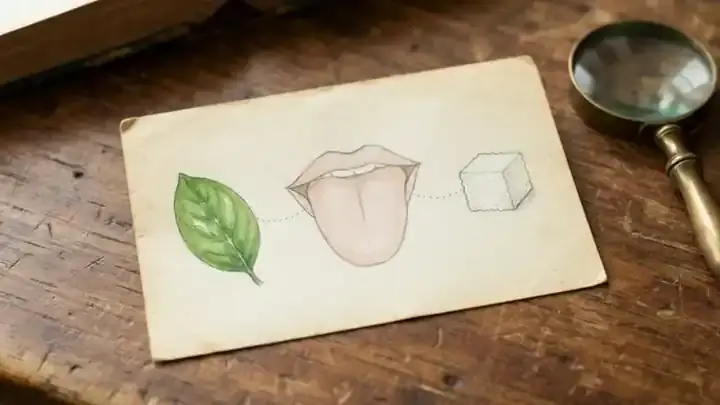
While they're sitting there, sugar can't register as sweet. Saliva gradually washes them away, which is why the effect fades in somewhere around half an hour to an hour.
Salt, sour and bitter come through normally. That's why the lemon bar still tasted like lemon.
Only the sweet channel goes quiet.
If you'd like to try the test yourself, here's how Meena and I ran it, written out the way I used to write a procedure for the children's science table.
It's a test about taste and nothing more. Most people laugh; Walt said a word I won't print.
That's the part of the gymnema story I'm comfortable telling you as fact, because the box says it, the tradition says it, and my own tongue says it.
Everything past the tongue is the part the 2021 review was trying to study, with all the caveats I just walked you through. I won't blur the two together, and you shouldn't let anyone else do it either.
Now, because a good catalog record says what a book isn't as clearly as what it is, here is what this tea is not.
- It isn't something you swallow with a glass of water. It's a tea bag of dried leaf, steeped in a cup like any other tea.
- It isn't a replacement for anything your clinician has given you or asked you to do. Not a substitute, not a "natural alternative," not a reason to skip a follow-up.
- It isn't a license to eat the whole box of kolaches. A quiet tongue for half an hour doesn't change what's in the pastry.
- It isn't a tested product for any outcome. No trial has been run on this box, and the company doesn't claim one.
- It isn't caffeinated. If your afternoon depended on coffee's jolt, this won't replace that, and it isn't trying to.
And one thing it is, which I'll put in a box of its own because it's the most important paragraph on this page.
I did exactly that, by the way. I'll tell you what my doctor said when we get to September.
How the Cup Found Its Place at Three O'Clock
Here's what I actually did with Meena's box, and why, in my own judgment, it earned a permanent spot on the kitchen counter.
I didn't drink it "for" anything. I drank it because I needed something warm at three o'clock that wasn't a dessert, and this was the first thing that didn't feel like a punishment.
The routine settled into this. Lunch at noon.
A fifteen-minute walk around the block with Walt, who complains about the heat from June through September and the wind from October through May.
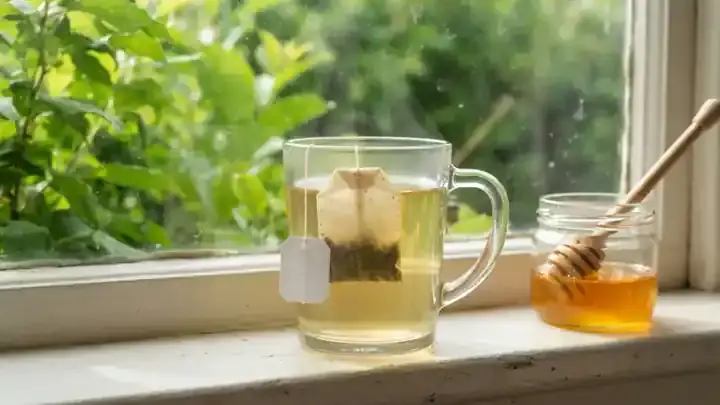
Then, around three, the kettle. One bag, the big blue mug, six minutes by the oven timer because I like it a little stronger than the minimum.
The taste took a week to like and two weeks to look forward to. Green, grassy, a little like the smell of a hayfield, with a bitterness at the end that reminded me of good black tea.
The seller suggests honey. I tried it once and laughed out loud, because if you stir honey into gymnema tea and sip it, the honey goes quiet on your tongue too.
Meena laughed even harder when I told her.
And then, after the cup, the kolache question. Some days I had half.
Some days I had a whole one and it tasted a little flat, which made it easier to stop at one. Some days I forgot it was in the box.
Saturdays stayed Saturdays. Walt still drives out to the bakery on the interstate, and I still meet him at the kitchen counter when he opens the white box.
The difference is that I now pour my cup first, and the box and I have a more civil conversation than we used to. I'm not going to pretend I've given up kolaches, and nobody asked me to.
I want to be honest about that, because it's the part people ask me about. Was that the tea?
Or the walk? Or the notebook?
Or simply a sixty-six-year-old woman finally paying attention?
I can't separate those things, and neither could any study. What I can tell you is that the cup gave the afternoon a shape, and a shape is easier to keep than a resolution.
There was one small change I'll allow myself to be pleased about, without assigning it to anything in particular.
Sometime in June, sitting in the green chair with the blue mug on the windowsill, I read Walt a paragraph out loud for the first time since winter. It was a passage about a heron, from a nature book the sale had sent home with me.
He put down the newspaper and listened all the way to the end. Then he said, "Read me the next one," and I did.
Reading 141 Reviews the Way I Used to Read a Card Catalog
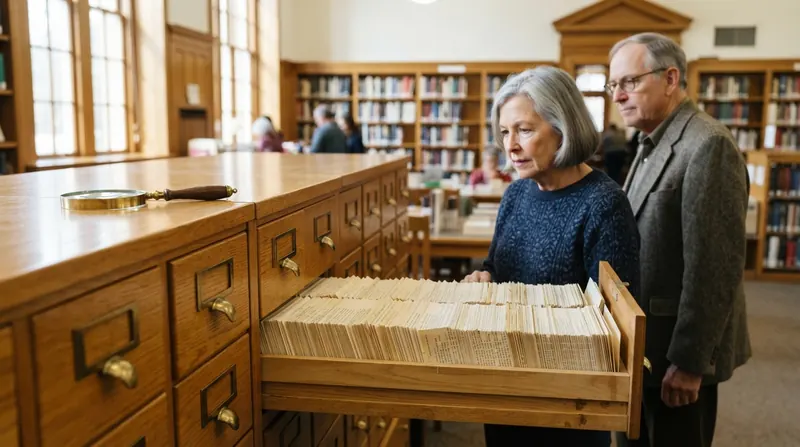
Before I ordered my own box, I read the reviews. All of them.
A librarian who doesn't read the whole drawer hasn't read the drawer.
The seller's page shows 4.8 stars from 141 reviews, collected through a review service that marks each one as a verified purchase.
I'll tell you what I noticed, because you'd notice it too if you sat with them long enough. Many of the newer reviews use very similar sentences, in slightly different orders, under different names.
That doesn't tell me anything bad about the tea in the cup. But it does tell me not to lean on that part of the drawer, the way I'd skip a shelf of books that all seemed to have been written by the same ghostwriter.
I also skipped every review that talked about readings, numbers or lab results. A review is one person's afternoon.
It isn't a lab, and a column that quotes it like one is doing you a disservice.
So I sorted the drawer the way I'd sort donations at the book sale: into piles.
One pile for reviews that described a result in somebody's body, which I set aside, because a stranger's afternoon is not evidence about mine. Another for reviews that read as if they'd come off the same typewriter.
And one very small pile of plain reviews about a box arriving, a box being what it said, or a shopper wanting more. That's the pile I'll show you.
I'll add one detail in the company's favor: it replies to many reviews with a short thank-you, which is courteous and tells you someone reads them.
What I kept were the plain old ones, short and unglamorous, the kind real people write when they're busy. Here are three of them, word for word.
Excellent product
Tried to order more, can't find this product on your website
Item received and in good condition.
Published by the seller on its product page, with the review service's verified-purchase mark. These describe one customer's experience with the product and the delivery; they don't establish any health benefit.
I know. "Item received and in good condition" is not going to make anybody weep.
But it's the review I trust most on the whole page, because nobody writes that sentence to sell you anything.
And Valerie's, from February 2024, is useful to anyone thinking of ordering: a five-star review whose whole text is that she wanted more and couldn't find it on the website.
When I checked the seller's page again on October 25, the tea was showing as unavailable in all three sizes. Stock on small-batch herbal teas comes and goes, so if you're curious, check availability before you plan around it.
For readers who skim, here's the whole drawer in one list. Clip it and stick it to the refrigerator if you like.
- One ingredient, organic gymnema leaf, about two grams per bag by the net weight on the box
- Caffeine-free, steeped five to seven minutes, a green and slightly bitter cup
- A taste effect you can feel: sweet things go quiet on the tongue for a while, as the box says
- A 2021 review of 10 small studies that's interesting, not proof, and not about tea bags
- $14.95 for 24 bags, about 62 cents a cup, with a 30-day return guarantee in the seller's words
- A Texas company with a published street address and a toll-free number that answers
My Afternoons, Week by Week, From April to September
Here's the honest diary, copied from the right-hand pages of the notebook. I've left out the pages read on purpose, because I don't think it's fair to hang them on the tea.
Borrower's card · afternoons, April to September
- Week 1First box from Meena. Cup at three, six minutes. Tasted like a hayfield. Whole kolache anyway, and it tasted flat. Walked with Walt twice.
- Week 2Nothing to report, and I mean that. Forgot the cup three days out of seven. Bought my own box online after checking the address and the phone number.
- Week 3A whole Saturday box arrived. I put two kolaches in the freezer for Walt "for later," which in our house means a week from Tuesday. Cup at three. Page 14, no nap.
- Week 4The three o'clock cup started happening without the oven timer reminding me. Walt asked if he could have one. He thinks it tastes like lawn clippings.
- Week 6A rainy week, no walks for four days. Cup at three anyway. Read Walt a paragraph out loud for the first time in months.
- Week 8Two kolache Saturdays in a row I stopped at half. Not willpower; the cup, the walk and the notebook simply made the half enough. Hard to say which did what.
- Week 12Summer heat. Moved the walk to after dinner and kept the cup at three. Meena brought a second box from her own pantry when mine ran out.
- Week 16Meena and I ran the sugar-cube test on her grandson at the book sale. He made the same face her cousin made in 1962. Ordered my second box.
- Week 20September follow-up appointment. Brought the box, the notebook and a long list of questions. Details below.
Can we move Tuesday to two-thirty? The room is free earlier.
11:02Yes, as long as we're done by three. That's my cup.
11:05Then bring the kettle and we'll all have one.
11:06Deal. Chapter nine, and I'll bring the bags.
11:08Week two gets the most honest line in the whole notebook: nothing to report. Anybody who promises you something in week two is selling you something else.
Week eight is the one I'm proudest of, and also the one I'm most careful about. I stopped at half a kolache twice.
I'd love to credit the tea. I'd also love to credit the walk, and the notebook, and Walt's company, and my doctor's blue ballpoint pen.
The truth is it was all of them, braided together. If you take one strand out, I can't tell you whether the rope still holds.
A few readers have asked what I'd do differently. I'd start the notebook a month before the tea, so I'd know what my ordinary afternoons looked like without it.
A scientist would call that a baseline, and it's exactly what the 2021 review was built on: each group compared with its own starting point. It's a fine way to describe a life and a weak way to prove a cause, which is why I don't use my notebook to prove anything.

What My Doctor Said When I Put the Box on Her Desk
In September I went back for the follow-up, and I did what I'd promised her in March. I brought what I'd found and we read it together.
I'd written my questions on index cards the night before, one per card, the way I used to prepare for a faculty consultation.
I put the box on her desk next to the notebook, and she picked up the box first. She read the side panel without a magnifying glass, which I found annoying.
She asked me how much I was drinking, when, and whether I'd changed anything else she'd told me to do. One cup at three, I said, and no, I hadn't changed a thing.
She went through the index cards one at a time and answered every one. She kept the last card, which I took as a compliment.
Then she read me something I hadn't known: because gymnema is studied for exactly the kind of numbers she watches, she wanted to know about it for the same reason she wants to know about everything else in my kitchen cabinet.
Her verdict was the one I'd expected, and I respected it. As a tea, with everything else in place, she didn't object.
As a plan, there was only one plan, and it was hers.
As for the circled line, we're still watching it, and we'll look again in the spring. I'm not printing it, and the tea gets neither credit nor blame on this page, because I don't know which it deserves.
What I do know is that my afternoons have a shape now, and I can describe that shape to my doctor in plain words. That's not a lab result.
It's a cataloged life.
What Readers Asked When the Short Version Ran
A shorter version of this column ran in the library newsletter in October. The comments were better than the column, which is usually how it goes.
The comments below are illustrative, retold with names shortened, and they're here because they ask the questions you're probably asking.
Corinne and Meena, Recorded Between the Book Boxes
After the October sale, Meena and I sat in the back room among the unsorted donations, with two cups of the tea from the community room's kettle, and talked into my phone for the library's little audio series.

Steady Glucose Reader · Back Room Tapes
The Sugar Cube, the Stacks and a Box Under the Julia Child
 Corinne
host
Meena, you put a box of tea on top of a stack of Julia Child in April and told me to try a lemon bar. Tell the people why.
 Meena
guest
Because you were staring at those lemon bars like a cat at a goldfish bowl. And because in my grandmother's house, the leaf came before the sweets. That was the game.
Corinne
host
And the sugar cube tasted like sand. I'll never forget it. But you know I went straight to the library and read the study.
Meena
guest
Of course you did. You read the study, you read the box, you read the reviews, you probably read the cardboard it came in. And what did you find?
Corinne
host
That the taste part is real, and the rest is small and interesting and not about tea bags. So I drink it at three because I like it, and the walk and the notebook do the rest of the work with it.
Meena
guest
That's the most librarian sentence I've ever heard. My grandmother would have said: it's a leaf, it's a cup, now go walk around the courtyard.
Corinne
host
Tell them about the first time you saw it in a store here.
Meena
guest
A health-food store in Dallas, maybe fifteen years ago: a whole shelf of jars and powders and tea, with words on the boxes my grandmother never used. I stood there and laughed. She'd have said, why are they selling the trellis?
Corinne
host
And you bought the tea.
Meena
guest
I bought the tea because it's the closest thing to the leaf, and because I don't trust anything that promises too much. A box that tells you it changes your taste for a while, that I believe. My tongue can check it.
Corinne
host
That's the whole column in one breath. The tongue can check the taste; everything else, you check with your doctor.
Meena
guest
And with a librarian, apparently.
Corinne
host
Your grandmother and my doctor would have gotten along. That's the episode. Next month: Meena explains the periodic table to me again, and I lose.
If you'd like to try a box for yourself, here's everything you need on one slip, the way I'd hand it to a patron at the desk.
One ingredient · caffeine-free · a Texas company with a phone that answers
The Return Guarantee, the Phone Line and the Fine Print
I promised my patrons for three decades that I'd read the boring part, so here's the boring part.
The seller lists a 30 Day Return Guarantee, in those words, on the product page. Thirty days isn't a year, and it's not a promise about how the tea will make you feel.
It's a return window.
If you're the kind of person who reads return policies, and I hope you are, call or email before you order and ask exactly how a return works for opened food items. Policies on opened tea vary, and the person on the phone is the right source, not me.
The contact details are printed on the company's own pages: (800) 820-4829, [email protected], and a mailing address at 312 Eldorado Pkwy, Suite 602, Little Elm, Texas.
A street address, a phone number and an email. In my experience, a company that prints all three is a company that expects to be found, and that's the first test I give any seller.
I'd ask those questions of any seller about any product.
Write the answers down, with the date and the name of the person you spoke to. Old habits.
What It Costs, Written on an Acquisition Slip
Now the money, written the way I used to write up a purchase request for the department, so nobody in the budget office could argue with me.
One box of 24 bags is $14.95. At one cup a day, that's a little over three weeks of afternoons, or about 62 cents a cup.
Three boxes, 72 bags, are $40.95, which works out to about 57 cents a cup. A case of six boxes, 144 bags, is $80.95, about 56 cents a cup.
I'm not going to tell you a tea is cheaper than your coffee habit and therefore a bargain. Walt still has his coffee, and I still have a kolache on some Saturdays.
I'll just say that 62 cents for a warm cup at three o'clock, with one honest ingredient and an address in Texas, is a price I could defend to any budget committee I ever sat on.
My one practical tip: start with a single box. If you don't like the taste after two weeks, you won't like it after six, and there's no reason to own a case of something you don't enjoy.
For planning purposes, at one cup a day: a single box covers about three and a half weeks of afternoons, three boxes about ten weeks, and a case of six a little under five months. Check the stock before you plan around any of them.
What the Women at the Book Sale Ask Me
Short answers from the reference desk
What exactly is in the bag?
One ingredient: organic gymnema sylvestre leaf. The box's net weight is 48 grams for 24 bags, about two grams of dried leaf per bag. No milligrams of any compound are printed.
Does it have caffeine?
No. It's a caffeine-free herbal tea, so it won't give you coffee's jolt, and it isn't trying to.
What does it taste like?
Green and grassy, a bit like a hayfield, with a slightly bitter finish. The seller suggests honey, though honey will taste muted for a while after you drink it.
Is the sugar-cube thing real?
Yes, and it's printed on the seller's page: gymnema may temporarily reduce the sensation of sweetness. It's a taste effect on the tongue that fades within an hour or so.
Has this tea been tested in a study?
Not this box. A 2021 review pooled 10 small studies of gymnema leaf powders and extracts in 419 adults already under a clinic's care. It's interesting research, not proof, and not about tea bags.
Can I drink it instead of what my doctor gave me?
No. It isn't a substitute for anything your clinician has given you or asked you to do. Bring the box to your appointment and keep following your care plan.
How do I make it?
The seller says one bag in eight ounces of hot water for five to seven minutes, one to two cups a day before meals. I drink one cup at three o'clock.
How do I reach the company?
Herbal Goodness LLC, (800) 820-4829, [email protected], 312 Eldorado Pkwy Ste 602, Little Elm, Texas.
Is it in stock?
On October 25 the seller's page showed it as unavailable in all three sizes. Stock comes and goes, so check availability on the seller's page.
Can I add honey?
You can, as the seller suggests, but expect it to taste muted for a while. That's the leaf doing exactly what the box describes.
Is it the same as gymnema powders or other forms?
No. Powders and extracts are different preparations. This box is dried leaf in bags for steeping, and nothing about other forms should be assumed to apply to it.
Who should talk to a clinician first?
Everyone, before the first cup, and especially anyone who keeps an eye on their glucose, follows an ongoing care plan, is pregnant or nursing, or takes anything daily. Bring the full label.
Will it replace my afternoon coffee?
Maybe not, and it doesn't have to. It's caffeine-free, so if you count on coffee to stay alert, this is a different kind of cup.
That last question is the one I get most often since this column started circulating, which tells you something about how many people in North Texas have a folded printout in their purse.
What I'd Tell My Sister, Over Coffee Without the Sugar

If my sister called me tonight with a circled line of her own, here's what I'd tell her, in the order I'd tell it.
First, call your doctor back and ask what she meant by the circle. Ask the question behind the question.
That conversation is worth more than anything in a box.
Second, find your afternoon. Mine was a kolache and three sugars and a nap at page eight.
Yours might be a soda at the desk or a bowl of ice cream at nine. You can't change a shape you haven't described.
Third, give the afternoon a new shape you'll actually keep. A walk, a notebook, a cup.
For me the cup turned out to be a green, bitter, oddly charming leaf from a vine in Meena's grandmother's courtyard.
Fourth, and Mrs. Purcell would insist I add this: read the label yourself, every line, before anybody tells you what it says.
Then ask every claim on it her three questions: compared with what, in whom, and made of what.
If a box survives those three questions, it has earned a place on your counter. If it doesn't, you've saved yourself the money and kept a little more of your afternoon.
And if you'd like to try that same leaf, read the slip below, ask your clinician, and check whether it's on the shelf.
Organic gymnema leaf · 24 bags · about 62¢ a cup · 30-day return window
P.S. The folded printout is still in the back pocket of the reading notebook, right where the date-due card used to go. It comes out at every appointment, along with the notebook and, these days, the box; if you have a folded printout of your own, start with the conversation, and let the cup come after.
P.P.S. Remember the sugar cube that tasted like sand. That's the one part of this story you can check for yourself, on your own tongue, in a minute. Everything else on this page, I checked for you in the stacks, and I told you exactly what I found and what I didn't.
The box, line by line, with what gymnema is, what the taste effect is and isn't, what the 2021 review measured and what it didn't, and which of our advertising headlines deserve your skepticism, is written out in the ingredient and advertising guide linked at the foot of this page.